Guide
Buy Canadian: what counts as Canadian, and what melted and poured means
Steel counts under Buy Canadian only if melted and poured in Canada. The $25 million and $5 million thresholds, the 10% and 25% levers, and what to keep.
On this page
The short answer
Under the federal Buy Canadian Policy, in force since 16 December 2025, steel counts as Canadian only if it was melted and poured in Canada, and aluminum only if it was smelted and cast here; cutting or machining it in Canada doesn’t change that. The materials rule applies to defence goods and construction procurements of $25 million or more that use at least $250,000 of the material. A separate policy gives eligible Canadian suppliers a 10% evaluation price reduction and puts 25% of the score on Canadian value added, for strategic procurements of $5 million or more since 15 June 2026.
The numbers
| What | Threshold | Since |
|---|---|---|
| Canadian materials policy: defence goods and construction procurements | $25 million and up, taxes included | 16 December 2025 |
| Canadian materials policy: each material (steel, aluminum, wood) within those | $250,000 or more of that material | 16 December 2025 |
| Canadian suppliers and content policy: strategic procurements | $5 million and up, taxes included | 15 June 2026 |
| The same policy, first phase | $25 million and up, taxes included | 16 December 2025 to 14 June 2026 |
| Evaluation price reduction for eligible Canadian suppliers | 10% of the financial proposal | 16 December 2025 |
| Weight on Canadian value added | 25% of the total evaluation score | 16 December 2025 |
| Records of material origin under the materials policy | Kept for seven years | 1 June 2026 |
| Buy Ontario: exclusion of US businesses | Any value | 13 April 2026 |
What changed
- The Canadian suppliers and content policy’s threshold fell from $25 million to $5 million. The materials policy stayed at $25 million.
- The compliance framework for the materials policy took effect: proof of origin at payment, and origin records kept for seven years.
- Ontario’s Buy Ontario Procurement Directive took effect, excluding US businesses from new public procurements at any value.
- The Buy Canadian Policy took effect, with its materials policy and its suppliers and content policy.
What counts as Canadian under Buy Canadian?
The federal Buy Canadian Policy took effect on 16 December 2025. It’s a framework with three policies under it: one on Canadian materials, one on Canadian suppliers and Canadian content, and one on reciprocal procurement.
For anyone who makes or buys machined metal parts, two of those policies matter, and they ask different questions:
- The materials test asks where the steel or aluminum was first made. Where it was later rolled, cut or machined doesn’t change the answer.
- The supplier and content test asks whether the business bidding is a Canadian supplier, and how much of its offer’s value is added in Canada.
A part machined in Nova Scotia from bar melted abroad can score well on the second test and still fail the first. That gap is what this guide is about.
What does “melted and poured” mean?
The Canadian materials policy defines Canadian steel as steel melted and poured in Canada, and the finished products made from it (Appendix C1). Melted and poured means the raw steel was first produced as a liquid in a steel-making furnace and poured into its first solid state here. The policy calls that place the country of melt and pour.
Aluminum has its own test, smelted and cast in Canada (Appendix C3), and it splits by form:
| Material | Counts as Canadian when | Forms a machine shop buys, from Appendix C |
|---|---|---|
| Steel | It was melted and poured in Canada | Carbon and alloy bars and rods (HS 7213 to 7215, 7227, 7228), flat-rolled products, tubes, fasteners (7318) |
| Aluminum other than sheet and plate | The largest volume of its primary aluminum was produced in Canada | Bars, rods and profiles (7604), tubes and pipes (7608) |
| Aluminum sheet and plate | Any percentage of its primary aluminum was produced in Canada | Plates, sheets and strip over 0.2 mm (7606) |
Wood products are the third material. We found no stainless flat-rolled or bar headings (7219 to 7222) on the steel list as modified on 20 February 2026. Check the current Appendix C before you rely on that.
When does the materials policy apply?
It covers defence goods procurements and construction procurements worth $25 million or more, taxes included, competitive or not. Inside those, each material counts on its own: the requirement applies to steel, aluminum or wood only where the contract will use $250,000 or more of it.
The lower threshold of June 2026 didn’t reach this policy. CanadaBuys confirmed on 16 June 2026 that the materials threshold stays at $25 million.
Every offeror signs a certification (Appendix D) committing to use Canadian materials, and an offer without it is disqualified. Exceptions exist, and each needs a minister’s approval: a cost increase of 25% or more, the public interest, no Canadian capacity, undue delay to critical defence or security operations, and commercial or military off-the-shelf products (questions and answers, 6 July 2026).
If you’re a subcontractor, the prime contractor keeps the obligation under the contract, per the compliance framework. Expect the prime to ask you for the evidence.
What does the suppliers and content policy add?
The Canadian suppliers and content policy covers strategic procurements in five sectors: defence and security; health and pharmaceutical; infrastructure, construction and transportation; information and communications technology; and consumer and industrial goods and materials (Appendix A). From 16 December 2025 it applied at $25 million and up. Since 15 June 2026 it applies at $5 million and up, taxes included, and CanadaBuys says about five times as many federal procurements now fall under it.
It works through two levers in the evaluation:
- A 10% evaluation price reduction. An eligible Canadian supplier’s financial proposal is evaluated as if it were 10% lower (section 5.2.2). The contract price doesn’t change.
- 25% of the score for Canadian value added. The buyer gives 25% of the total evaluation score to Canadian value added (section 5.3.1), or applies a price credit of the same weight. The score is the offer’s Canadian value added divided by its total value, times the weight: an offer with 60% Canadian value added earns 15 of 25 points.
Canadian value added counts a Canadian good, the portion of a good produced in Canada, and costs incurred here for work such as customization, logistics and after-sales service. A Canadian supplier has a permanent, named place of business in Canada, registers and files taxes here, and doesn’t subcontract abroad in a way that leaves little value added in Canada. Materials already required under the materials policy are left out of the value added calculation (Appendix E).
For a machine shop, the machining done here counts toward value added wherever the bar was melted. The country of melt decides only the materials test.
What evidence should a shop or buyer keep?
The materials policy’s compliance framework, in effect since 1 June 2026, sets out what contractors owe:
- proof of origin and chain of custody documents for every in-scope steel, aluminum or wood product;
- an estimate of materials after award, updated with each progress payment or invoice;
- proof-of-origin documents at payment, which the project authority reviews before it pays;
- complete records of material origin, kept for seven years.
Missing proof can lead to liquidated damages, retained holdbacks, termination, or ineligibility for future contracts.
The policy doesn’t name a document type. For bar and plate, the document that comes from the mill is the mill certificate, also called a mill test report, which ties the metal to its heat number. For each job, keep:
- the mill certificate for each heat, showing the country of melt for steel, or where the primary aluminum was produced;
- the supplier’s packing slip and invoice that link the heat to your purchase order;
- your own traveller or job record that links each heat to the parts cut from it;
- for the suppliers and content policy, the line-item Canadian value added you attested to, with the labour and costs behind it.
The contracting authority can ask for supporting documents for those attestations at any time, including after award. Ask for certificates that state the country of melt when you place the order.
A note on Buy Ontario
Ontario’s Buy Ontario Procurement Directive took effect on 13 April 2026. Section 4.3 excludes US businesses, meaning a head office in the US and fewer than 250 full-time employees in Canada, from new goods and services procurements at any value, with narrow exceptions.
It measures origin by cost. A Canadian-Made Good is wholly manufactured in Canada or originates here, has at least 51% of its total direct costs incurred here, or carries a Canadian origin label. For capital infrastructure, bidders file a Domestic Supply Chain Plan naming the source of each major good, and steel and other metals are on that list. There’s no melt test in the directive, so a part can meet Ontario’s cost test while its steel fails the federal one.
How CanadaFab handles it
- We buy the metal for each job through our network of Canadian metal suppliers, and ask for mill certificates with every buy request. A Canadian supplier can sell steel melted anywhere, so the certificate decides.
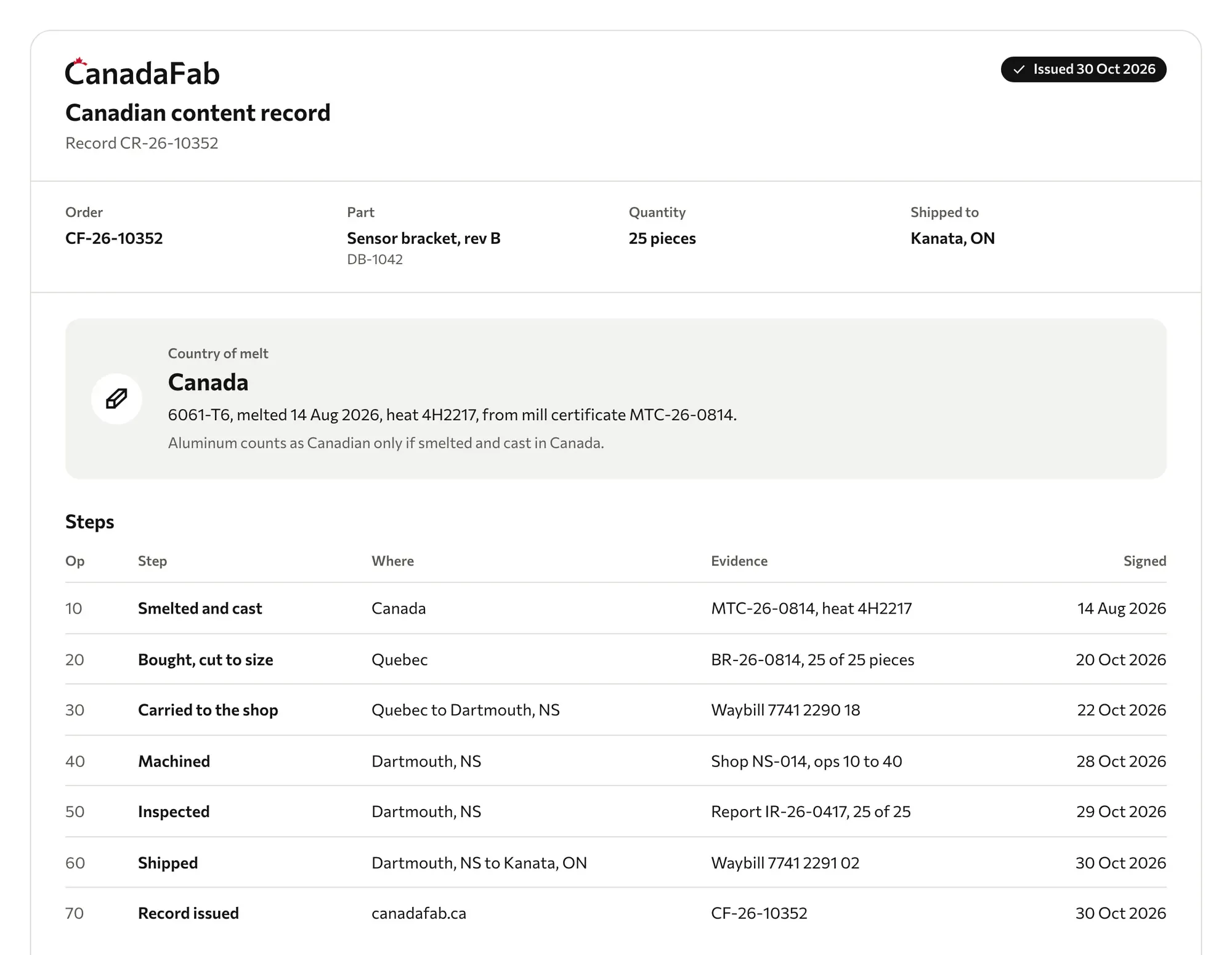
- Each order’s Canadian content record carries each mill certificate’s heat number and country of melt, beside the shop and its province, the labour and the carriers.
- The record states the country of melt as the certificate shows it, including when that isn’t Canada.
- When a buyer tells us a job falls under the materials policy, we source to that test and keep the certificates with the record, so the prime can answer a request for proof.
The offeror still signs the attestation. The record is the evidence behind it.
This guide is general information, not legal advice. Check the current policy text, and ask the contracting authority or your counsel about a specific bid.
Sources
- Buy Canadian Policy, CanadaBuys, page dated 20 July 2026.
- Policy on Prioritizing Canadian Materials in Federal Procurements, CanadaBuys, page dated 20 February 2026.
- Policy on Prioritizing Canadian Suppliers and Canadian Content in Strategic Federal Procurements, CanadaBuys, page dated 20 February 2026.
- Buy Canadian update: strategic procurement threshold lowered to $5 million, CanadaBuys, page dated 17 June 2026.
- Compliance Framework: Policy on Prioritizing Canadian Materials in Federal Procurement, CanadaBuys, page dated 20 July 2026.
- Questions and Answers for Suppliers, CanadaBuys, page dated 6 July 2026.
- Buy Ontario Procurement Directive, Government of Ontario, page dated 22 May 2026.
General information, not legal advice. Check the primary sources before you rely on a number.