Guide
Sourcing metal: mill certificates and the country of melt
Where to buy metal for machined parts in Canada, how to read a mill certificate, and the country of melt that Buy Canadian has counted since 16 December 2025.
On this page
The short answer
Buy small lots from cut-to-size suppliers and plate or volume from service centres, and order the mill certificate with the metal. The certificate ties the metal to a heat number, its chemistry and its mechanical properties, and it’s where you find the country of melt. Under the Buy Canadian Policy, in force since 16 December 2025, steel counts as Canadian only if it was melted and poured in Canada, and aluminum only if it was smelted and cast in Canada.
The numbers
| What | Rule | Since |
|---|---|---|
| Federal procurements covered by the Canadian materials policy | Defence goods and construction worth $25 million or more, taxes included | 16 December 2025 |
| Material threshold | $250,000 or more of steel, aluminum or wood products on the contract | 16 December 2025 |
| Steel that counts | Melted and poured in Canada, and finished products made from that steel | 16 December 2025 |
| Aluminum that counts | Smelted and cast in Canada, and finished products made from that aluminum | 16 December 2025 |
| Surtax on metal melted in China | 25% on certain goods containing steel melted and poured, or aluminum smelted and cast, in China | 31 July 2025 |
| Proof for that surtax | Certificates only, such as a mill test certificate; commercial invoices no longer accepted | 22 September 2025 |
What changed
- Canada’s counter-tariffs on certain US steel and aluminum products moved to 25% or 50%, depending on the product.
- The Buy Canadian Policy took effect. Under its Canadian materials policy, steel counts if melted and poured in Canada and aluminum if smelted and cast in Canada.
- The CBSA stopped accepting commercial invoices as proof of the country of melt and pour for the China surtax. Only certificates count.
- A 25% surtax began on certain steel and aluminum goods containing steel melted and poured, or aluminum smelted and cast, in China.
- Reporting the country of melt and pour became mandatory for steel imports under Canada’s general import permits.
Where do machine shops buy metal in Canada?
Most metal for machined parts comes from two kinds of seller, and the size of the order decides which one fits.
Service centres hold plate, bar, tube and sheet in volume and process it before it ships. For example, Russel Metals says its service centres offer plasma and laser cutting, saw cutting and shearing (Russel Metals, read 26 September 2026). Samuel lists service centres in Laval, Quebec, and in Stoney Creek, Hamilton and Cambridge, Ontario (Samuel). Metalium has five branches: Beloeil, Rimouski, Gatineau and Chicoutimi in Quebec, and Moncton in New Brunswick (Metalium, read 29 September 2026). When we read the public pages of national service centres on 23 and 25 September 2026, none showed a price without an account, a minimum order value or a cut fee.
Cut-to-size suppliers sell by the piece. They cut bar and plate to the length you need, some of them the same day, and some advertise no minimum order. They suit prototypes and small batches.
A simple rule: small lots and short lead times go to cut-to-size suppliers; plate, full bars, processing and repeat volume go to service centres. Whichever you use, ask for the mill certificate, and its type, when you order.
What does a mill certificate show?
A mill certificate is the producing mill’s record for the heat your metal came from. You’ll see it called a mill test certificate, a mill test report (MTR) or, under the European standard EN 10204, an inspection certificate. BS EN 10204:2004, published on 25 October 2004, sets the types of inspection document for metallic products such as plates, sheets, bars, forgings and castings.
The type tells you who stands behind the numbers. The manufacturer validates types 2.1 and 2.2, and a 2.2 test report gives results of non-specific inspection. A 3.1 inspection certificate gives results of specific inspection, validated by an inspection representative the manufacturer authorizes, who works independently of production. A 3.2 certificate adds a second signature, from the purchaser’s representative or an inspector named by official regulations (Penflex, Engineering Bulletin 121, summarizing the standard).
| On the certificate | What it tells you | Why it matters |
|---|---|---|
| Specification, grade and temper | The standard the metal meets, for example ASTM A276 type 304 or 6061-T651 | It has to match the drawing; a different temper is a different material |
| Heat number | The batch melted together at the mill; some aluminum certificates call it a cast or lot number | It links each part to its test results and to the mill that melted the steel |
| Chemical analysis | The measured composition of that heat | It confirms the grade from the heat’s own analysis |
| Mechanical properties | Tensile and yield strength, elongation and, where the specification asks, hardness | It shows the heat met the specification’s limits |
| Mill and country of melt | Who melted the heat, and where | It decides whether the steel counts under Buy Canadian, and whether some surtaxes apply |
| Certificate type and signature | 2.2, 3.1 or 3.2, and who validated it | It tells you whether the results are specific to your delivery |
| Order, size and quantity | The purchase order, dimensions and pieces or weight shipped | It ties the certificate to the delivery in front of you |
Where does the country of melt appear?
For steel, the country of melt and pour is the country where a steel-making furnace first produced the raw steel as liquid and poured it into its first solid shape (Global Affairs Canada, modified 7 November 2024). Since 5 November 2024, importers bringing steel in under Canada’s general import permits have had to report it. Global Affairs Canada accepts documents that carry the heat number or code of the mill that first melted and poured the steel, and mill test certificates are among them.
On a certificate, look for a stated country of melt, or the name of the melting mill beside the heat number. For aluminum, look for where it was smelted and cast. Don’t read the country of melt from the supplier’s address, or from the country where the bar was rolled, drawn or cut. A general “country of origin” line may cover something else, so ask what it means. If the certificate you get is a distributor’s own document with no heat number or melting mill, ask for the original mill certificate before the metal is cut.
The Canada Border Services Agency uses the same evidence for tariffs. Since 22 September 2025 it accepts only certificates, such as a mill test certificate, to show that steel wasn’t melted and poured in China or that aluminum wasn’t smelted and cast there; commercial invoices no longer count (Customs Notice 25-28, modified 7 November 2025).
Why does the country of melt matter under Buy Canadian?
The Policy on Prioritizing Canadian Materials in Federal Procurements took effect on 16 December 2025 as part of the Buy Canadian Policy. It covers federal defence goods and construction procurements worth $25 million or more, taxes included, where the contract needs $250,000 or more of steel, aluminum or wood products. Steel counts only if it was “melted and poured” in Canada, and aluminum only if it was “smelted and cast” in Canada, along with finished products made from them. In our reading, cutting, machining or selling the metal in Canada doesn’t change that.
The proof runs up the supply chain. Under the policy’s compliance framework (modified 20 July 2026), contractors send proof-of-origin documents with each progress payment or invoice and keep records of material origin for seven years. Falling short can bring liquidated damages, termination of the contract or disqualification. A prime working to that rule will ask its suppliers for the chain of custody, and for a machined part, that chain starts at the mill certificate.
Tariffs add a price reason to know the melt. Since 31 July 2025, a 25% surtax has applied to certain steel and aluminum goods containing steel melted and poured in China or aluminum smelted and cast in China (Department of Finance Canada, modified 24 September 2026).
What should the shop check when the metal arrives?
Check the delivery against the order and the certificate before anyone cuts a chip, and keep it apart until it passes:
- Count and size, against the packing slip and the cut list.
- Grade and temper, from the marking or the tag, against the order and the drawing.
- The heat number on the metal or its tag, against the heat number on the certificate.
- The certificate type (3.1 if the order asked for it), with chemistry and mechanical results inside the specification’s limits.
- The country of melt, when the job needs it.
- Damage, with photos, so a claim can go to the supplier or the carrier while its window is still open.
Then mark each cut piece with its heat number, because tags come off. A quality consultant noted in March 2026 that the supplier’s tag is often the only link from a bundle of bars to its certificate, and recommended marking material at receiving (Kaizen ISO Consulting, 15 March 2026).
On a CanadaFab job, the shop checks the metal within 48 hours of delivery.
How does CanadaFab handle the metal?
- We buy the metal for each job through our network of Canadian metal suppliers: small lots from cut-to-size suppliers, plate and larger projects from national service centres, for example Russel Metals and Samuel.
- The metal is its own line on your quote, in Canadian dollars, beside machining and freight.
- Every buy request asks for the mill certificate with the heat number and the country of melt, and for a 3.1 certificate when your order calls for one.
- The supplier cuts the metal to size and ships it to the shop with its mill certificates, each piece tagged with its heat number and job number.
- The shop checks it within 48 hours, and we keep the certificate in Montreal, linked to your parts.
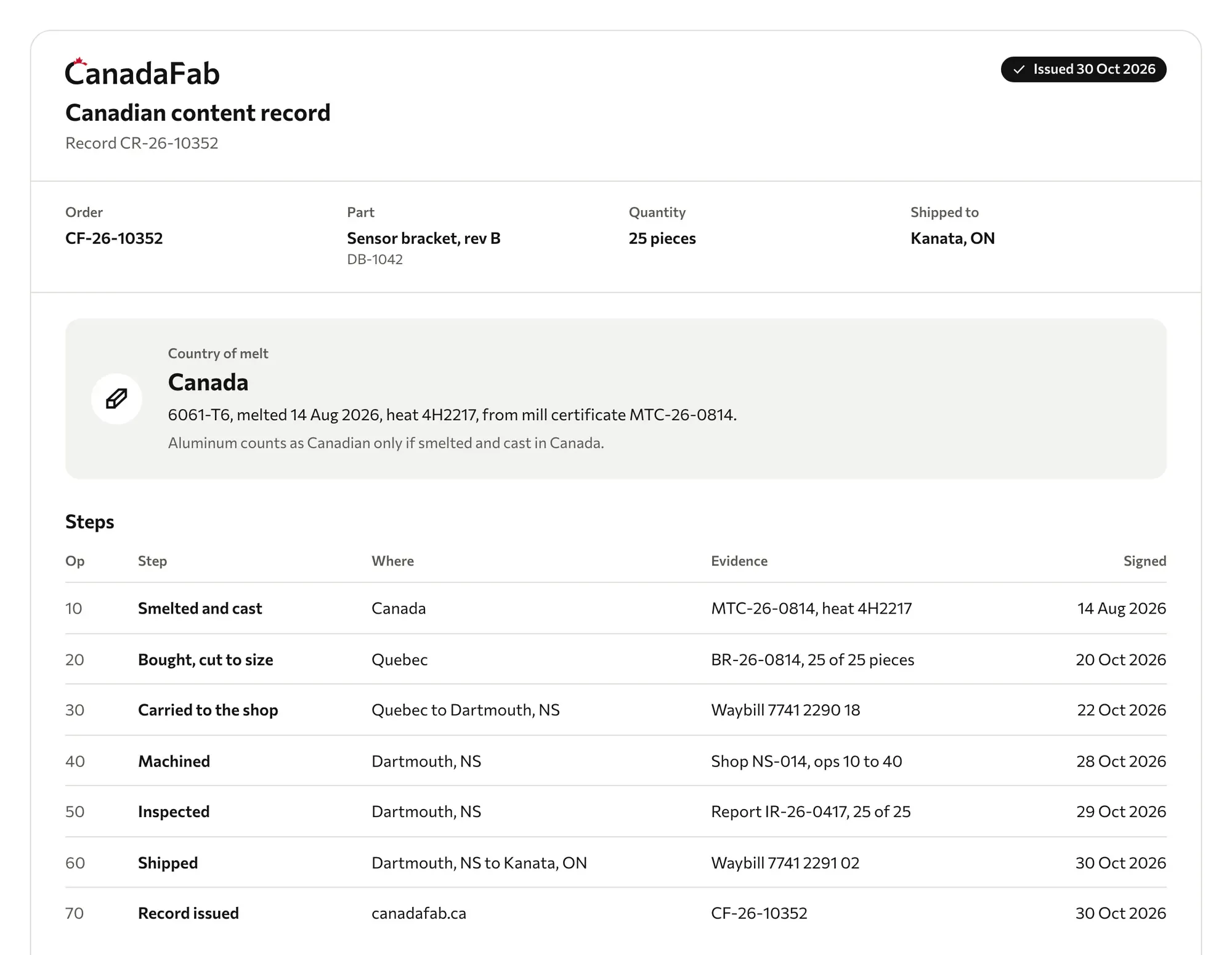
- The heat number and the country of melt go onto the Canadian content record, whatever the country. If the steel was melted in the United States, the record says so. We take the country from the certificate, never from the supplier’s address.
Where a job needs steel melted and poured in Canada, we ask for it on the buy request and show any difference in price or lead time on the quote.
Sources
- Policy on Prioritizing Canadian Materials in Federal Procurements, CanadaBuys, page dated 20 February 2026.
- Compliance Framework: Policy on Prioritizing Canadian Materials in Federal Procurement, CanadaBuys, page dated 20 July 2026.
- Buy Canadian Policy, CanadaBuys, page dated 20 July 2026.
- Country of melt and pour updates for steel imports, Global Affairs Canada, page dated 7 November 2024.
- Customs Notice 25-28: Steel Goods and Aluminum Goods Surtax Order, Canada Border Services Agency, page dated 7 November 2025.
- Canada’s tariffs: steel and aluminum, Department of Finance Canada, page dated 24 September 2026.
- Canada announces targeted countermeasures and substantive support for workers and businesses in response to U.S. tariffs, Department of Finance Canada, page dated 25 August 2026.
- BS EN 10204:2004, Metallic products. Types of inspection documents, BSI, page dated 25 October 2004.
- Engineering Bulletin 121, BS EN 10204:2004 types of inspection documents, Penflex, page dated 31 July 2025.
- Metals service centres (Russel Metals companies page), Russel Metals, page dated 26 September 2026.
- Locations, Samuel, Son & Co., page dated 26 September 2026.
- Succursales, Metalium, page dated 29 September 2026.
- Material traceability: beyond the certification shuffle, Kaizen ISO Consulting, page dated 15 March 2026.
General information, not legal advice. Check the primary sources before you rely on a number.